Concept Simulators / Copies and agreement
A cluster, end to end
Add and kill nodes, split the network, and watch keys, leadership and traffic react together.
On the roadmap:Advanced · step 4: Distributed systems
Cluster
- N1 · leader
- N2
- N3
- N4
Traffic
Network
Nodes up
4 of 4
Leader
N1
Requests
0
Errors
0 (0%)
Everything is healthy. Kill a node, or split the network, to see how the cluster responds.
Where the keys live (consistent hashing)
4 nodes sharing 500 keys. Imbalance: 1.08x the average — close to even.
Request latency
Send a request or a burst to see latency.
Event log
- Cluster started with 4 nodes. N1 is leader for term 1.
In plain words
A real cluster is not one idea in isolation. It is a set of nodes that hold keys (consistent hashing), agree on a leader for writes (election), and answer requests spread across whoever is up (load balancing) — and a network partition hits all three at once. This simulation keeps one small cluster and lets you poke at it from every angle instead of one sim per concept.
Why it matters
Most lessons isolate one idea to make it learnable, which is right for a first pass. But in production, a node going down is never just a hashing problem or just an election problem: it is both, at the same time, and the two interact. Seeing them on one cluster is closer to the real debugging experience of 'why did this fail' than four separate tools.
How real systems do it
The simulation is a simplified model. Here is what production systems add or do.
- etcd, the coordination store behind Kubernetes, uses the Raft algorithm for exactly this: a majority of nodes must agree before a write is considered committed, and a minority partition stops accepting writes rather than risk disagreement.
- Cassandra separates these concerns differently: it has no single leader for writes (any node can accept one), trading the 'only a majority can write' guarantee for always being able to write somewhere, then reconciling later.
- Google's Chubby and Spanner both pay the latency cost of cross-region consensus deliberately, because for a lock service or a globally consistent database, a split-brain (two nodes both believing they're the leader) is worse than being briefly slower.
- Production clusters are usually deployed with an odd number of nodes (3, 5, 7) specifically so a partition can never produce two equal halves with no majority anywhere — the 'even split' experiment above is the scenario odd sizing exists to avoid.
Study: A cluster, end to end
Once you have played with it, learn the same idea from people who build these systems. Watch first for the picture, then read for the detail.
 9 min
System Design Primer ⭐️: How to start with distributed systems?
Gaurav Sen · 2.0M views
Then
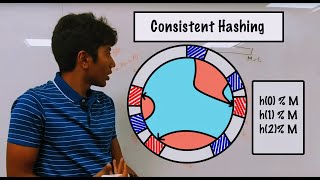 11 minWhat is CONSISTENT HASHING and Where is it used?Gaurav Sen · 1.1M views
 8 minConsistent Hashing | Algorithms You Should Know #1ByteByteGo · 436K views
 15 minDistributed Systems 1.1: IntroductionMartin Kleppmann: Distributed Systems Lectures · 379K views
 7 minConsistent Hashing: Easy Explanation for System Design InterviewsHello Interview · 197K views