Concept Simulators / Copies and agreement
Distributed transactions
Two-phase commit against a saga when a service fails or says no.
On the roadmap:Advanced · step 4: Distributed systems
Settings
How the services agree
What goes wrong
A coordinator runs a prepare phase, then a commit or abort phase. Locks are held between the two.
Result
Committed everywhere
Steps with locks held
6
Steps where others saw it half-done
0
All three agreed, so the transaction committed everywhere. The cost was 6 steps with locks held across services, and a round trip of messages before any of it counted.
Step 8 of 8
Shipping commits and releases its locks.
Payment
committed
no locks
Inventory
committed
no locks
Shipping
committed
no locks
The same failure, both ways
| Approach | Result | Steps with locks held | Seen half-done |
|---|---|---|---|
| Two-phase commit | Committed everywhere | 6 | 0 |
| Saga | Committed everywhere | 0 | 2 |
In plain words
When one business action touches several services, each with its own database, no single database transaction covers it. Two-phase commit makes every service agree before any commits. A saga lets each commit straight away, and undoes earlier steps with compensating actions if a later one fails.
Why it matters
Both are ways to keep several services consistent without a shared database, and they fail very differently. Two-phase commit never shows a half-finished result, but it can block. A saga never blocks, but other users can see it half done, and its undo is a new action rather than a rollback.
How real systems do it
The simulation is a simplified model. Here is what production systems add or do.
- Two-phase commit is part of the XA standard, and databases such as PostgreSQL and MySQL support prepared transactions. Google Spanner uses two-phase commit across its groups of replicas.
- Because a prepared participant must wait for the coordinator, long outages leave locks held. Coordinators therefore keep their decision in durable storage, and are usually replicated.
- The saga pattern goes back to a 1987 paper by Hector Garcia-Molina and Kenneth Salem. Workflow tools such as Temporal and AWS Step Functions run sagas by saving each step's progress.
- Every saga step and compensation should be idempotent, because a message can be delivered twice. A compensation is a new business action, such as a refund, and may not be able to restore things exactly.
Study: Distributed transactions
Once you have played with it, learn the same idea from people who build these systems. Watch first for the picture, then read for the detail.
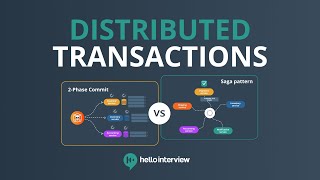 15 min
Distributed Transactions Explained: 2 Phase Commit vs Saga Pattern
Hello Interview · 289K views
Then
 31 minDo you know Distributed transactions?Tech Dummies - Narendra Lakshmana Gowda · 240K views
 31 min4. SAGA Pattern | Strangler Pattern | CQRS | Microservices Design Patterns | System DesignConcept && Coding - by Shrayansh · 189K views
 17 minSaga Pattern | Distributed Transactions | MicroservicesByteMonk · 137K views
 19 minDistributed Systems 7.1: Two-phase commitMartin Kleppmann: Distributed Systems Lectures · 87K views