Library / Case Studies
Moving persistent data out of Redis at Github
Historically, we have used Redis in two ways at GitHub: We used it as an LRU cache to conveniently store the results of expensive computations over data originally persisted in…
By Github engineers · Github · Added 2026-10-12
All content belongs to Github engineers / Github. We only link to it and give credit. Report a problem
Learn this case study
About 37 min left. Your work is saved as you go.
What you are about to study
Github explains a real system. You should know the basics: caching, queues and replication.
Ideas you will meet
- Caching
- Cache-aside, write-through, eviction and invalidation strategies.
- Redis
- In-memory data structures for caching, queues and leaderboards.
- Distributed Systems
- Consensus, time, failure and the fundamentals of scale-out.
What we already know about this
Our own lessons on these ideas. Read them here before you start, so it makes sense.
Core Concepts: How Things Actually Work · 8 minWhy Redis is fast, and Redis versus MemcachedIn-memory storage, a single-threaded event loop and rich data structures, plus how persistence and replication work.Read here
Why it is fast
- Everything lives in memory. No disk seek on the read path.
- Simple, efficient data structures (hash tables, skip lists, compact encodings) with predictable costs.
- A single-threaded event loop for command execution: no locks between threads, no context switching, and each command runs atomically. I/O multiplexing lets one thread serve thousands of connections.
- A lean protocol and in-process memory management.
(Newer versions use extra threads for network I/O, but command execution stays ordered.)
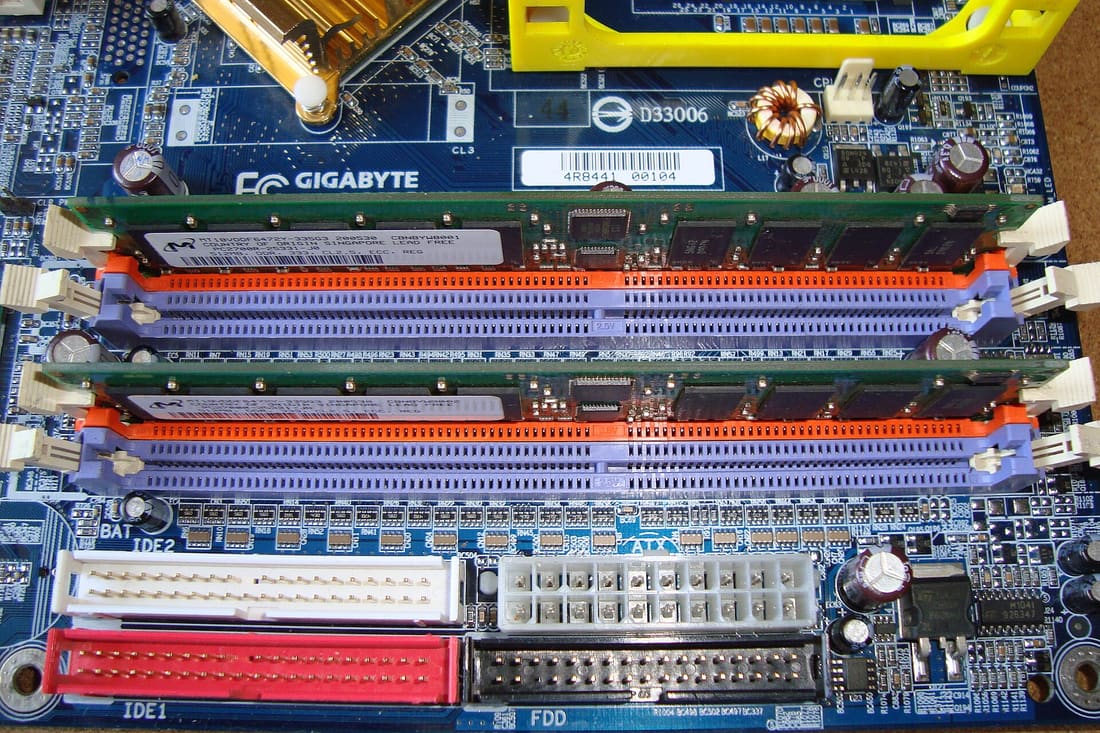 Image: Mixabest · Public domain · Source · Wikimedia Commons: Dual-channel DDR memory use 6026
How the pieces fit
100%Figure SDA-CORE-09-1 · Redis: event loop, memory, persistence and replication · © forcsguy.com
More than a cache
Redis stores typed values:
Type Use String cached values, counters, flags Hash objects with fields (a user profile) List queues, recent items Set unique members, tags, set maths Sorted set leaderboards, priority queues, time-ordered data Others streams, bitmaps, HyperLogLog, geospatial Because operations run on the server, you can increment, push, pop or intersect without a read-modify-write race.
100%Figure SDA-CORE-09-2 · Redis data types and what they are for · © forcsguy.com
Durability options
Memory is volatile, so Redis offers:
- Snapshots (RDB): periodic point-in-time dumps. Compact, but recent writes can be lost.
- Append-only file (AOF): logs every write; replays on restart. Safer, bigger and a little slower.
- Or none at all when it is purely a cache.
Scaling and availability
- Replication: a primary copies to replicas (asynchronously), serving reads and enabling failover.
- Sentinel / managed failover promotes a replica when the primary dies.
- Cluster: splits keys across nodes by hash slot, for data larger than one machine.
Redis versus Memcached
Redis Memcached Data types many strings only Persistence optional none Replication yes not built in Threading one for commands multi-threaded Best for cache plus data structures, queues, counters a very simple, large, pure cache For most new projects Redis is the more flexible choice. Memcached remains fine for a straightforward cache that must use many CPU cores.
Pitfalls
- Memory is finite: set a maxmemory and an eviction policy (for example LRU).
- Avoid slow commands on huge collections.
- A very hot key still concentrates load on one node.
More on this site
Related reading
- Redis DocumentationRedis · Redis Ltd.Documentation
- Redis BlogRedis engineers · Redis Ltd.Blogs
- Redis UniversityRedis · Redis Ltd.Courses
- RedisRedis · Redis Ltd.GitHub
Show 6 moreShow fewer
- Redis persistenceRedis · Redis Ltd.Documentation
- Memory Optimization in Redis at WattpadWattpad engineers · WattpadCase Studies
- Scale with Redis ClusterRedis · Redis Ltd.Documentation
- Scaling Job Queue with Redis at SlackSlack engineers · SlackCase Studies
- Moving persistent data out of Redis at GithubGithub engineers · GithubCase Studies
- PayPal Developer Community BlogPaypal engineers · PaypalBlogs
Search, Analytics and Geo · 10 minNearby search with Redis GEOHow Redis stores locations in a sorted set using geohash scores, how GEOSEARCH finds nearby members, how to expire stale entries, and when to move to a spatial database.Read here
The problem
"Show the nearest available drivers", "stores within 3 km", "friends nearby". The data is a large set of points that change often, and the question is always about a small neighbourhood. You want a fast, in-memory structure.
How Redis does it
Redis stores locations in an ordinary sorted set. Each member (a driver id) has a score that is a 52-bit geohash of its longitude and latitude. Geohash interleaves the bits of the two coordinates so that nearby places have nearby scores. A search turns a radius into a few score ranges, reads those ranges, then filters by exact distance.
100%Figure SDA-SAG-09-1 · A nearby query in Redis · © forcsguy.com
Typical commands:
GEOADD drivers:blr 77.5946 12.9716 driver:42
GEOSEARCH drivers:blr FROMLONLAT 77.60 12.97 BYRADIUS 2 km ASC COUNT 20 WITHDIST
Design details
- Partition the key. One sorted set for the whole planet is a hot spot and slow to search. Use a key per city, region or grid cell so each set is small and local, and shard keys across nodes.
- Updates are cheap. Moving a member is another GEOADD, about O(log n). 75,000 updates per second is manageable on a few nodes.
- Freshness. Sorted set members have no individual expiry. Keep a second sorted set
lastseenwith the update time as score, and run a job that removes members older than, say, 30 seconds from both sets. - Availability filter. Store only drivers who are available, or look up status after the search; keep the hot set small.
- Accuracy. Redis uses a spherical model of the Earth, so distances can be off by a fraction of a percent, and results near a cell boundary rely on the exact filter. That is fine for "within 2 km", not for surveying.
- Durability. Treat Redis as a rebuildable copy. The system of record is a database, and clients re-send their location every few seconds anyway.
100%Figure SDA-SAG-09-2 · Keeping the hot set fresh · © forcsguy.com
When Redis GEO is not enough
Move to a spatial database such as PostGIS, or a purpose-built index, when you need polygons and fences, joins with other tables, constraints (opening hours, vehicle type) together with distance, or durable queries over history. Many systems combine them: a database for rich queries and Redis for the live, hot position data.
Other grid systems are covered in the geofencing lesson and in the real-world reading: H3 (hexagons, good for aggregation and neighbours) and S2 (cells on a sphere).
Real-world reading
Advanced Distributed Systems · 12 minRedis: persistence, replication, Sentinel and ClusterWhat keeps an in-memory database from losing data and from being a single point of failure: snapshots, the append-only file, replicas, Sentinel and hash slots.Read here
Fast because it is in memory, durable because of logs
Redis keeps its dataset in RAM (the reason it is so fast; see the Redis and Memcached lesson). To survive a restart it offers two persistence mechanisms, which can be combined.
Snapshots (RDB)
Redis periodically writes a point-in-time snapshot of the whole dataset to disk, using a forked child process so the main process keeps serving. Snapshots are compact and quick to load, but anything written since the last snapshot is lost on a crash.
Append-only file (AOF)
Redis appends every write command to a log. On restart it replays the log. The fsync policy sets the loss window:
Policy Behaviour Risk alwaysFlush after every command Slowest, almost no loss everysecFlush once per second At most about a second lost (common default) noLet the OS decide Fastest, larger loss The AOF grows, so Redis periodically rewrites it into a compact form. Many deployments use AOF with
everysec, sometimes plus snapshots for fast backups.100%Figure SDA-ADS-04-1 · Redis persistence choices · © forcsguy.com
Replication and Sentinel
A Redis primary replicates to one or more replicas asynchronously. Replicas serve reads (possibly slightly stale) and can take over. Sentinel is a small set of monitor processes that:
- watch the primary and replicas,
- agree by quorum that the primary is down,
- promote a replica and tell clients where the new primary is.
100%Figure SDA-ADS-04-2 · Sentinel failover · © forcsguy.com
Because replication is asynchronous, a failover can lose the last few acknowledged writes. Redis offers settings to reduce this (for example requiring a minimum number of replicas to acknowledge), at the cost of availability.
Redis Cluster: sharding
When data or traffic outgrow one node, Redis Cluster shards the keyspace into 16,384 hash slots. A key's slot is a hash of the key modulo that number; each node owns a range of slots, and each primary has replicas. Clients learn the slot map and talk to the right node; a wrong guess gets a redirect.
- Resharding moves slots (and their keys) between nodes while the cluster runs.
- Multi-key operations only work when all keys are in the same slot. Hash tags (a
{tag}part of the key) force related keys into one slot. - Failover is built in: replicas of a failed primary are promoted by the cluster.
- This is the "fixed number of slots" cousin of consistent hashing (see the consistent-hashing lesson).
Which setup when
Need Choice Pure cache, loss acceptable Single node or replicas, little or no persistence Must survive restart AOF (everysec) and snapshots Must survive node loss Replica plus Sentinel Data larger than one node, or very high throughput Redis Cluster Also keep memory in mind: set a max memory and an eviction policy (see the caching lessons) so Redis behaves predictably when full, and watch for large keys and slow commands, which block a single-threaded executor.
Real-world reading
Related reading
- Redis DocumentationRedis · Redis Ltd.Documentation
- Redis persistenceRedis · Redis Ltd.Documentation
- Redis UniversityRedis · Redis Ltd.Courses
- Redis BlogRedis engineers · Redis Ltd.Blogs
Show 6 moreShow fewer
- Scale with Redis ClusterRedis · Redis Ltd.Documentation
- RedisRedis · Redis Ltd.GitHub
- Failover with Redis Sentinel at VintedVinted engineers · VintedCase Studies
- Memory Optimization in Redis at WattpadWattpad engineers · WattpadCase Studies
- Speeding Up Redis with Compression at DoorDashDoorDash engineers · DoorDashCase Studies
- Availability in Globally Distributed Storage Systems at GoogleGooglePapers
Go deeper on this
A path through videos, articles, other case studies and code on the same ideas as Moving persistent data out of Redis at Github.
Warm upGet the vocabulary first.
Documentation
Redis Documentation
Data types, persistence, replication, clustering and caching patterns.
Redis Ltd.Beginner
Courses
Redis University
Free courses on Redis data structures, search, and caching patterns.
Redis Ltd.Beginner
WatchHow others solve the same problem, on video.
Videos belong to their creators and play from YouTube. More on YouTube (opens in a new tab)
ReadEngineers explain it in their own words.
Blogs · Free from the author · Read here
Scalable Web Architecture and Distributed Systems
A full chapter on the building blocks of large websites: availability, performance, reliability, scalability, caches, proxies, indexes, load balancers and queues. Free to read here under CC BY 3.0.
The Architecture of Open Source ApplicationsBeginner40 min
Blogs
High Scalability
Long-running blog dissecting the architectures of large internet companies.
High ScalabilityIntermediate
See it in another companyThe same ideas, a different system.
Case Studies · Read here
Optimizing Redis Storage at Deliveroo
Counting unique users, checking if a credit card has already been used, or checking if this is a mobile user’s first visit ever — all of these require maintaining a large set of fingerprints (unique visitor ID, card f...
DeliverooIntermediate
Case Studies · Read here
Redis Fleet at Heroku
How the Heroku Data infrastructure team manages large fleet operations, such as this one required by a recent Redis remote code execution vulnerability.
HerokuIntermediate
Read the codeSee how it looks when it is real.
GitHub
Awesome Scalability
Curated reading list of articles on the architecture of scalable, reliable systems.
binhnguyennusIntermediate
GitHub
Redis
The source of the in-memory data store, a compact C codebase worth reading.
Redis Ltd.Advanced
Keep learning
Loading community…