Designing for failure: reliability
Timeouts, retries, circuit breakers, rate limiting and redundancy: how systems stay up when parts of them break.
On the roadmap:Intermediate · step 8: Reliability and observability
Lesson 10 of 13 · 12 min read · quiz · exercise
Failure is normal
At scale something is always broken: a disk, a network link, a deployment, a dependency having a bad day. Reliable systems do not avoid failure, they expect it and contain it.
Two words to keep apart:
- Availability: the fraction of time the system works (99.9% allows about 8.8 hours of downtime a year; 99.99% about 53 minutes).
- Durability: the chance stored data is not lost.
Remove single points of failure
A single point of failure (SPOF) is any component whose failure takes everything down. Hunt for them:
- Run several application servers behind a load balancer.
- Replicate databases and plan failover (lesson 5).
- Spread across availability zones, and for the most critical services, across regions.
- Do not forget the "invisible" ones: the load balancer, DNS, a certificate that expires, a single queue.
Figure SDA-FND-10-1 · Removing single points of failure tier by tier · © forcsguy.com
Protect calls between services
Most outages spread through calls between components. Four basic defences:
1. Timeouts
Every network call needs a timeout. Without it a slow dependency holds your threads hostage. Set timeouts based on what a healthy call looks like (for example a little above the 99th percentile), and make inner timeouts shorter than outer ones.
2. Retries, carefully
Transient errors often succeed on a second try. But retries multiply load on a struggling service, so:
- Retry only idempotent operations or those with an idempotency key (lesson 8).
- Use exponential backoff with jitter.
- Cap the number of attempts, and ideally cap the share of traffic that can be retries.
3. Circuit breakers
If a dependency keeps failing, stop calling it for a short time and fail fast.
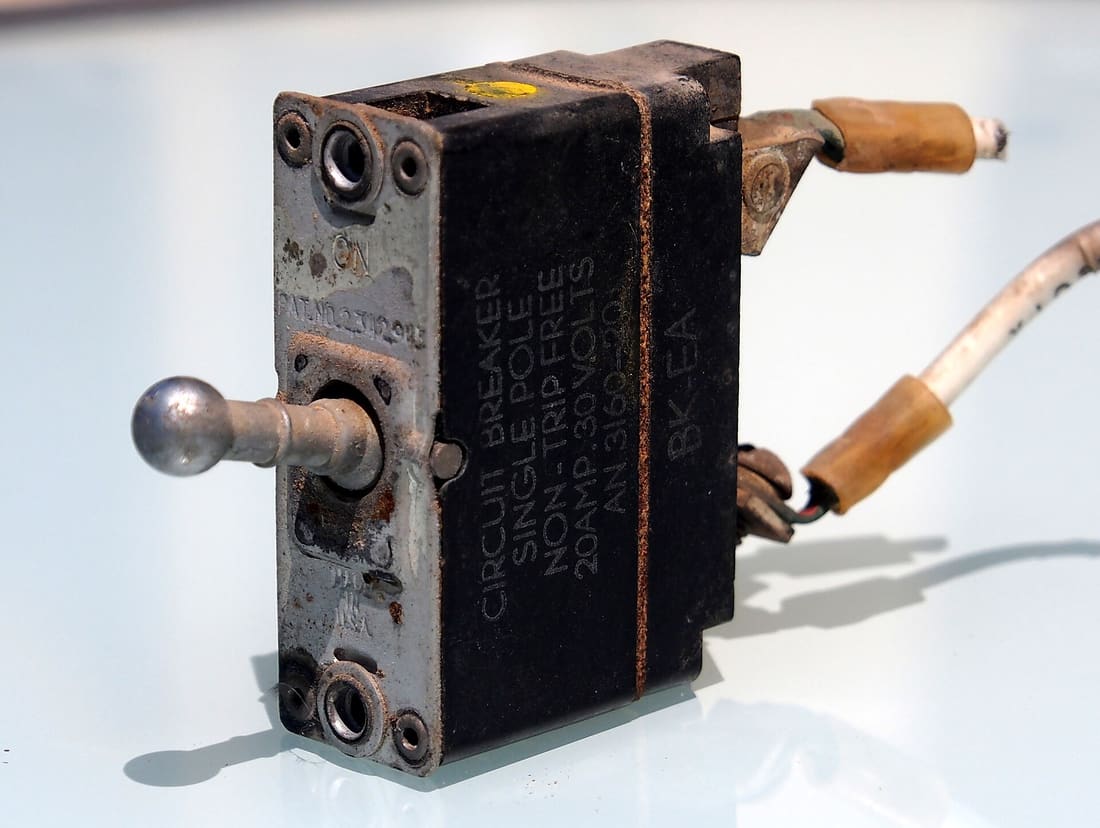 Image: Alf van Beem · CC0 · Source · Wikimedia Commons: Circuit breaker, Single pole, Non-tripfree, 20Amp-30Volts, AN 3160 pic1
Figure SDA-FND-10-2 · Circuit breaker states · © forcsguy.com
- Closed: normal operation, failures are counted.
- Open: calls fail immediately, saving resources.
- Half-open: a few trial calls check whether the dependency has recovered.
4. Bulkheads
Give each dependency its own pool of threads or connections, like watertight compartments in a ship, so one slow dependency cannot use up everything.
Before: a slow dependency drags everyone down
After: a breaker cuts the slow dependency off
What changed
- Callers stop waiting on a failing service
- Threads and connections are not used up
- A fallback answer is returned while the service recovers
Protect yourself from too much traffic
- Rate limiting caps how many requests a client may make (common algorithms: token bucket, sliding window). It protects against abuse and accidental floods.
- Load shedding: when overloaded, deliberately reject low-priority work early so important requests still succeed. It is better to serve 80% of requests well than 100% badly.
- Back pressure: tell producers to slow down instead of letting queues grow without bound.
Degrade gracefully
When a non-critical part fails, keep the rest working: show the page without recommendations, serve cached prices, queue the email. Decide in advance which features are essential.
Practise failure
- Health checks so traffic leaves broken instances.
- Chaos testing: deliberately kill instances in a controlled way to prove the system copes.
- Runbooks and game days so people have rehearsed the response.
A worked example: the arithmetic of availability
Downtime in a month. 99% allows about 7.3 hours; 99.9% about 43 minutes; 99.99% about 4.4 minutes; 99.999% about 26 seconds. Each extra nine is ten times harder and usually much more expensive, so choose the target your users need, not the biggest number.
Dependencies in series multiply. If a request needs three services, each 99.9% available, the request is available only 0.999 x 0.999 x 0.999 = 99.7%, about 2 hours 11 minutes of downtime a month. The more things in the critical path, the worse it gets, which is why teams shorten the critical path and make non-essential calls optional.
Redundancy in parallel helps. Two independent replicas, each 99% available, are both down only 1% x 1% = 0.01% of the time: 99.99% together. The word "independent" carries all the weight: replicas that share a rack, a deploy, a bug or a dependency fail together, and the formula no longer applies.
Retries multiply load. If every one of 1,000 requests per second fails and each caller retries 3 times, the failing service sees up to 4,000 requests per second, making recovery harder. And if three layers each retry 3 times, one user request can become 64 attempts at the bottom. Retries need limits, backoff with jitter, and a retry budget (for example, retries may be at most 10% of normal traffic).
Figure SDA-FND-10-3 · How availability combines · © forcsguy.com
Anatomy of a cascading failure
The classic outage is rarely one failure; it is one failure that spreads.
- A database gets slow (a bad query, a noisy neighbour). Responses that took 10 ms now take 5 seconds.
- App servers wait on it. Each request holds a thread for 5 seconds, so threads and connections fill up.
- The app can no longer accept new requests, even ones that do not need the database. The load balancer sees timeouts and marks servers unhealthy, so the same traffic lands on fewer servers.
- Callers time out and retry, which adds load to the already struggling system.
- Everything is down, and fixing the original slow query no longer brings it back, because the retry storm keeps it overloaded.
The defences are cheap compared with the outage:
- Timeouts on every call, shorter than the caller's own timeout.
- Circuit breakers that stop calling a failing dependency for a while and fail fast.
- Bulkheads: separate thread or connection pools per dependency, so one slow one cannot use all of them.
- Load shedding: when overloaded, reject some requests early to keep serving the rest.
- Backoff with jitter and retry budgets.
Figure SDA-FND-10-4 · A circuit breaker protects both sides · © forcsguy.com
Mistakes people make
- No timeouts, or timeouts longer than the caller's. The default in many libraries is "wait forever" or minutes.
- Retrying everything everywhere. Retry only safe, idempotent operations, at one layer, with backoff, jitter and a budget.
- Health checks that lie. A server that answers
/healthbut cannot reach its database should fail the check. - Untested failover. Failover that has never run is a guess. Practise it on purpose, in business hours.
- Shared fate. Two "redundant" systems in one zone, on one deploy pipeline, or on one dependency are one system.
- No graceful degradation. Decide in advance which features can be switched off (recommendations, images, analytics) to protect the critical path.
Try it yourself
In the System Builder, lose three servers at peak and find how much spare capacity you need. Read the resilience patterns lesson for circuit breakers and bulkheads in more depth, and build the lease leader election lab to see failover without split brain.
Related reading
- Timeouts, retries, and backoff with jitterAmazon Builders' Library · Amazon Web ServicesBlogs
- Using load shedding to avoid overloadAmazon Builders' Library · Amazon Web ServicesBlogs
- Maglev: A Fast and Reliable Software Network Load Balancer (paper)Eisenbud et al. · GooglePapers
- Designing robust and predictable APIs with idempotencyBrandur Leach · StripeBlogs
Show 6 moreShow fewer
- Circuit BreakerMartin FowlerBlogs
- Circuit Breaker patternMicrosoft · Microsoft AzureDocumentation
- Google SRE Book: Addressing Cascading FailuresGoogle SRE team · GoogleBlogs
- Google SRE Book: Handling OverloadGoogle SRE team · GoogleBlogs
- Testing for Disaster Recovery Failover TestingUSENIX engineers · USENIXCase Studies
- Improved Production Stability with Circuit Breakers at HerokuHeroku engineers · HerokuCase Studies
Check your understanding
Question 1 of 4
0 correct so far
Why must every network call have a timeout?
Go deeper
- Timeouts, retries and backoff with jitter by Amazon Builders' Library
- Site Reliability Engineering, Addressing Cascading Failures by Google SRE team
Topics covered in this lesson
Practise it: Survive losing servers
Everything below is already set up for this lesson: change the design, run the traffic, and see whether you meet the goal.
- 1The task
- 2Build and test
A bad deploy takes three of your app servers down at 20 seconds, at peak.
Goal: Under 2% errors after the loss.
Capacity planning is about the failure case. How many servers can the survivors afford to lose?
Try it yourself
Service A calls service B, which calls a payment provider. The provider starts responding in 30 seconds instead of 200 ms. Describe how the slowness spreads and list the protections you would add, in order.
Click what a strong design here would need:
Next course
© 2026 forcsguy.com. Original lesson text and diagrams. Books and sites linked above belong to their authors.