Library / Case Studies
Erlang at Facebook (slides)
How Facebook's chat backend used Erlang processes to hold huge numbers of connections and route messages.
By Eugene Letuchy · Facebook · Added 2026-10-12
All content belongs to Eugene Letuchy / Facebook. We only link to it and give credit. Report a problem
Learn this case study
About 37 min left. Your work is saved as you go.
What you are about to study
Facebook explains a real system. You should know the basics: caching, queues and replication.
Ideas you will meet
- WebSockets
- Persistent bidirectional connections for real-time features.
- Distributed Systems
- Consensus, time, failure and the fundamentals of scale-out.
What we already know about this
Our own lessons on these ideas. Read them here before you start, so it makes sense.
Core Concepts: How Things Actually Work · 7 minPolling, long polling, SSE and WebSocketsFour ways to get live updates to a browser, and how to choose between them.Read here
The problem
HTTP is request and response: the client asks. How does the server tell a browser something now?
The four options
Technique How Good Weak Short polling Client asks every N seconds Trivial, works everywhere Wasteful, delayed by N Long polling Client asks; the server holds the request until there is news (or a timeout), then the client asks again Near real time, plain HTTP A held request per client, awkward at scale Server-sent events (SSE) One long HTTP response streams events Simple, auto-reconnect, text over HTTP One-way only WebSockets HTTP upgrades to a two-way connection Low latency both ways Stateful connections, more infrastructure 100%Figure SDA-CORE-08-1 · The four options · © forcsguy.com
Before: polling: keep asking
100%After: WebSocket: server pushes
100%What changed
- No wasted requests when nothing has changed
- Updates arrive the moment they happen
- The server must hold many open connections
Choosing
- Updates are rare or delays are fine: polling.
- The server pushes, the client mostly listens (feeds, scores, notifications, progress): SSE.
- Both sides send often (chat, games, collaborative editing): WebSockets.
Running persistent connections
Connections are long-lived, so capacity is about how many connections a server can hold, not requests per second.
- Put connection handling in servers that are separate from your stateless API.
- Use heartbeats to detect dead connections, and reconnect with backoff and jitter.
- Track which server holds which user so messages can be routed (a presence or session store), and use a pub/sub system between servers.
- When a client reconnects, let it ask for what it missed (events after id X), because connections drop.
- Authenticate on connect and again when tokens expire.
More on this site
Related reading
- RFC 6455: The WebSocket ProtocolIETFDocumentation
- MDN: WebSockets APIMDN Contributors · MozillaDocumentation
- Uber's Real-Time Push PlatformUber Engineering · UberCase Studies
- How Discord Scaled Elixir to 5,000,000 Concurrent UsersDiscordCase Studies
Show 6 moreShow fewer
- The WhatsApp Architecture Facebook Bought for $19BHigh ScalabilityCase Studies
- Erlang at Facebook (slides)Eugene Letuchy · FacebookCase Studies
- Slack EngineeringSlack engineers · SlackBlogs
- Real-time MessagingSlack Engineering · SlackCase Studies
- How Uber Scales Their Real-time Market Platform - High Scalability -High Scalability engineers · High ScalabilityCase Studies
- Real-Time Predictions at DoorDashDoorDash engineers · DoorDashCase Studies
Classic System Designs · 13 minDesign a chat systemReal-time one-to-one and group messaging: persistent connections, message routing, ordering, storage and presence.Read here
The problem
A chat system lets people exchange messages in real time, one-to-one and in groups, on several devices, with history and online status.
Requirements
- Low latency delivery (under a second when both are online).
- 1-to-1 and group chat (say up to a few hundred members).
- Online/offline presence.
- Multiple devices per user; message history; push notifications.
- No lost messages.
Why not plain HTTP
With HTTP, the client asks and the server answers. To receive a message the client would have to poll repeatedly: wasteful and slow. Chat uses a persistent connection, usually WebSocket, so the server can push a message the moment it arrives.
Polling, long polling, WebSocket
- Polling: the client asks every few seconds. Simple, but most answers are "nothing new" and each costs a request.
- Long polling: the server holds the request open until a message arrives or a timeout passes, then the client asks again. Better, but the server that holds the request may not be the one that receives the message (a stateless load balancer spreads requests), the server cannot easily tell the client has gone, and a quiet user still reconnects on every timeout.
- WebSocket: starts as an HTTP request, is upgraded, and stays open in both directions. It usually passes firewalls because it uses the web ports. It can carry sending as well as receiving, so one mechanism does both; ordinary actions (sign-up, profile) can stay on plain HTTP.
Connections are the scarce resource, not memory: at roughly 10 KB per connection, a million concurrent users need only about 10 GB, so the real limits are the number of connections per machine and, above all, not having a single machine as a single point of failure.
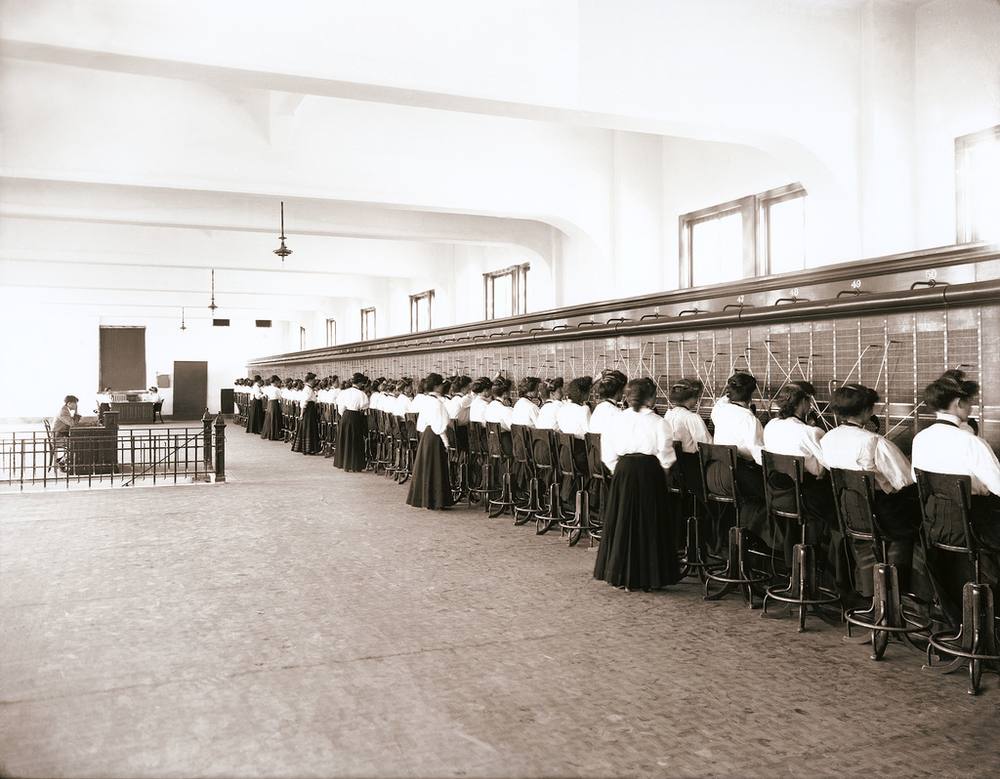 Image: The Salt Lake Herald · Public domain · Source · Wikimedia Commons: Telephone switchboard 6 Oct 1907 Salt Lake City100%
Figure SDA-CSD-08-1 · Polling versus long polling · © forcsguy.com
100%Figure SDA-CSD-08-2 · WebSocket upgrade · © forcsguy.com
Before: plain HTTP polling
100%After: persistent WebSocket
100%What changed
- Messages arrive instantly instead of on the next poll
- Far fewer wasted requests
- Servers must keep many open connections
High-level design
Separate two kinds of traffic:
- Stateless request/response work (sign-in, profile, history lookup): normal API servers behind a load balancer.
- Stateful real-time work: chat servers holding the WebSocket connections.
100%Figure SDA-CSD-08-3 · Chat servers, message store and push · © forcsguy.com
Message flow (1-to-1)
- A sends the message over its WebSocket to its chat server.
- The server assigns a message id (increasing within the conversation) and stores it.
- It looks up which chat server B is connected to (a session store) and forwards the message.
- If B is online, it is delivered over B's WebSocket. If offline, a push notification is sent and the message waits in storage.
- B's client acknowledges receipt; receipts flow back to A.
100%Figure SDA-CSD-08-4 · Stateless and stateful parts of a chat system · © forcsguy.com
100%Figure SDA-CSD-08-5 · Connecting to the right chat server · © forcsguy.com
100%Figure SDA-CSD-08-6 · One-to-one message path · © forcsguy.com
Groups
For small groups, deliver the message to each member's inbox (or sync queue). It is the same flow repeated per member. For very large groups, switch to a pull model where members fetch new messages on open, as in the news feed lesson.
100%Figure SDA-CSD-08-7 · Small group chat as inboxes · © forcsguy.com
Storing messages
Chat produces enormous write volume and is mostly read as "the latest messages of a conversation". That suits a key-value or wide-column store partitioned by conversation, with messages sorted by id. Relational databases struggle at this scale, though they are fine for user and group data.
Keep recent messages hot and move old ones to cheaper storage.
Two details on storage keys. For one-to-one chat the message id alone orders the messages (never the creation time, since two can share a timestamp). For group chat use a composite key of channel id plus message id, with the channel as the partition key because every query is within one channel. Ids only need to be ordered within a conversation, so a per-conversation counter is simpler than a global generator. Key-value stores suit this because the data has a long tail of old messages that large relational indexes handle poorly, and because well-known chat products run on wide-column stores.
Ordering and sync
- Device clocks cannot be trusted, so the server assigns ids.
- Each client remembers the last id it saw per conversation and on reconnect asks for everything after it. The same mechanism syncs multiple devices.
Presence
Show online/offline status with heartbeats: while connected, the client sends a small ping every few seconds. If heartbeats stop for a while, mark the user offline. Do not announce every blip: wait a grace period so a flaky connection does not make a user flicker. For large friend lists, fetch presence on demand or only for visible contacts to avoid a flood of updates.
100%Figure SDA-CSD-08-8 · Syncing several devices · © forcsguy.com
100%Figure SDA-CSD-08-9 · Presence with heartbeats · © forcsguy.com
100%Figure SDA-CSD-08-10 · Publishing status changes to friends · © forcsguy.com
Scaling and failure
- Connection capacity: a chat server holds many thousands of connections, so scale by adding servers; keep per-connection memory small.
- Server failure: clients reconnect (with backoff and jitter) to another server and sync missed messages.
- Service discovery: choose a chat server for a new connection with a load-aware or consistent-hash assignment.
- Security: authenticate on connect, use TLS, and consider end-to-end encryption, which means the server cannot read message content and affects features like search.
Worked numbers: connections and message rate
Assume 50 million daily users, 10 million online at peak, each sending 40 messages a day.
- Connections: 10 million open WebSockets. One well-tuned server can hold on the order of 100,000 mostly idle connections, limited by memory per connection (tens of KB) and file descriptors. So you need about 100 chat servers, plus spare, say 130.
- Message rate: 50M x 40 = 2 billion messages a day, about 23,000 per second on average, 70,000 at peak.
- Storage: at 100 bytes per message (text plus metadata) that is 200 GB a day, 73 TB a year before replication and media. That is a write-heavy, append-mostly workload suited to a store that handles large sequential writes and range reads by conversation, such as a wide-column database, rather than a single relational node.
- Heartbeats: if every connected client sends a heartbeat every 30 seconds, that is 10M / 30 = 333,000 tiny messages per second just to know who is online. Presence is often more expensive than chat itself, which is why designs batch and sample it.
100%Figure SDA-CSD-08-11 · Sizing a chat system · © forcsguy.com
What happens when a chat server dies
A server holding 100,000 connections crashes. What do those users experience?
- Their clients notice the connection dropped (immediately if the socket closes, after a heartbeat timeout otherwise).
- Each client reconnects with jittered, exponential backoff; without jitter, 100,000 clients reconnect in the same second and overload the next server (a reconnect storm).
- The load balancer routes them to healthy servers, which register the connections in the session registry.
- Each client sends the id of the last message it received; the server replays anything newer from the message store. No message is lost, because messages were saved before being delivered.
- Presence flips offline then online; debounce this so friends do not see a flicker.
This works only because the connection servers hold no source of truth: messages live in the store, and the connection is just a pipe.
100%Figure SDA-CSD-08-12 · Recovering after a chat server fails · © forcsguy.com
Delivery guarantees you can state
Chat promises are about at least once delivery with idempotent handling: the sender assigns each message a unique id; the server stores it before acknowledging; the recipient acknowledges receipt; if no acknowledgement arrives the message is redelivered, and the client discards duplicates by id. Ordering is guaranteed within a conversation by a sequence number per conversation (not by wall-clock time, which differs between devices). Say clearly that you do not promise global ordering across conversations, because that would not scale.
Mistakes people make
- Using the client's clock for ordering. Clocks differ; use a server-assigned sequence per conversation.
- Acknowledging before saving. If the server crashes after the ack but before the write, the message is lost. Save first.
- Large groups as many small inboxes. Writing a message into the inbox of every member of a 100,000 person group is a fan-out explosion; use a shared timeline that members read instead.
- Stateful connection servers. Keep nothing important in a connection server's memory; make reconnection cheap.
- Treating presence as exact. "Online" is a best-effort guess; design the UI around that.
Try it yourself
The System Builder challenge "A burst of writes" mirrors saving messages: a queue protects the store. For real-time connection basics, read the WebRTC lesson and compare when you would use WebSockets and when peer-to-peer. Or open a chat-shaped design on the free canvas and kill a part to see what survives.
More on this site
Related reading
- Flannel: An Application-Level Edge Cache to Make Slack ScaleSlack Engineering · SlackCase Studies
- How Discord Scaled Elixir to 5,000,000 Concurrent UsersDiscordCase Studies
- RFC 6455: The WebSocket ProtocolIETFDocumentation
- Uber's Real-Time Push PlatformUber Engineering · UberCase Studies
Show 6 moreShow fewer
- How Discord Stores Billions of MessagesDiscordCase Studies
- Erlang at Facebook (slides)Eugene Letuchy · FacebookCase Studies
- Slack EngineeringSlack engineers · SlackBlogs
- Real-time MessagingSlack Engineering · SlackCase Studies
- Storing Messages with Cassandra at DiscordDiscord engineers · DiscordCase Studies
- Real-time Distributed Tracing at LinkedInLinkedIn engineers · LinkedInCase Studies
Go deeper on this
A path through videos, articles, other case studies and code on the same ideas as Erlang at Facebook (slides).
Warm upGet the vocabulary first.
Books · Free from the author
Concurrent and Distributed Systems (Cambridge lecture notes)
Eight lectures on time, broadcast, replication, consensus and transactions, with notes, slides and video. Free from the author under CC BY-SA.
University of CambridgeIntermediate
Books · Free from the author
High Performance Browser Networking
How TCP, TLS, HTTP/2, WebSocket and mobile networks affect web performance; free to read.
O'ReillyIntermediate
WatchHow others solve the same problem, on video.
Videos belong to their creators and play from YouTube. More on YouTube (opens in a new tab)
ReadEngineers explain it in their own words.
Blogs
Slack Engineering
How Slack builds messaging, search, job queues and infrastructure.
SlackIntermediate
Blogs · Free from the author · Read here
Scalable Web Architecture and Distributed Systems
A full chapter on the building blocks of large websites: availability, performance, reliability, scalability, caches, proxies, indexes, load balancers and queues. Free to read here under CC BY 3.0.
The Architecture of Open Source ApplicationsBeginner40 min
See it in another companyThe same ideas, a different system.
Case Studies · Read here
Brooklin: Distributed Service for Near Real-Time Data Streaming at LinkedIn
Brooklin—a distributed service for streaming data in near real-time and at scale—has been running in production at LinkedIn since 2016, powering thousands of data streams and over 2 trillion messages per day. Today, w...
LinkedInIntermediate
Case Studies · Read here
Concourse: Generating Personalized Content Notifications in Near-Real-Time at LinkedIn
Social media are computer-mediated platforms that facilitate creation and sharing of information, ideas, career interests, and other forms of expression via virtual communities and networks. In the last few years, not...
LinkedInIntermediate
Read the codeSee how it looks when it is real.
GitHub
Engineering Blogs
A huge directory of company engineering blogs to learn from real production systems.
kilimchoiIntermediate
GitHub
Awesome Scalability
Curated reading list of articles on the architecture of scalable, reliable systems.
binhnguyennusIntermediate
Keep learning
Loading community…