Library / Case Studies
Omid: Transaction Processing Platform at Yahoo
yahoodevelopers: By Ohad Shacham, Yonatan Gottesman, Edward Bortnikov Scalable Systems Research, Verizon/Oath Omid, an open source transaction processing platform for Big Data, was born as a research project at Yahoo (now part of Verizon), and became an Apache Incubator project in 2015. Omid complements Apache…
By Yahoo engineers · Yahoo · Added 2026-10-12
All content belongs to Yahoo engineers / Yahoo. We only link to it and give credit. Report a problem
Learn this case study
About 37 min left. Your work is saved as you go.
What you are about to study
Yahoo explains a real system. It assumes you are comfortable with distributed systems.
Ideas you will meet
- Machine Learning Systems
- Recommendations, ranking, feature stores and serving models at scale.
What we already know about this
Our own lessons on these ideas. Read them here before you start, so it makes sense.
Big Data and Cloud Data Platforms · 12 minBatch and stream processingMapReduce and Spark for large batch jobs, and streaming concepts: event time, windows, watermarks and exactly-once results.Read here
Two ways to process data
- Batch: process a bounded dataset (yesterday's logs) as a job that starts, runs and finishes. High throughput, results later.
- Stream: process an unbounded flow of events continuously as they arrive. Low latency, harder to get right.
Most platforms need both: stream for fresh insight, batch for heavy recomputation and history.
Before: batch: a big job on a schedule
100%After: stream: process each event
100%What changed
- Results arrive in seconds instead of hours
- Late and duplicate events must be handled
- Batch stays useful for reprocessing history
Batch: the MapReduce idea
Word count is the classic example.
100%Figure SDA-BDP-02-1 · MapReduce word count flow · © forcsguy.com
- Map: each worker reads a slice and emits key-value pairs (
("system", 1)). - Shuffle: the framework groups all pairs with the same key and sends them to the same reducer. This is the expensive step (network and sorting).
- Reduce: each reducer combines the values for its keys (
("system", 4812)).
Failures are handled by re-running tasks, which is possible because inputs are immutable and tasks have no side effects.
Spark improved this model: it keeps intermediate data in memory, expresses jobs as chains of transformations on DataFrames (with a query optimiser), and offers SQL, machine learning and streaming APIs on one engine. Today you usually write Spark or SQL, not raw MapReduce.
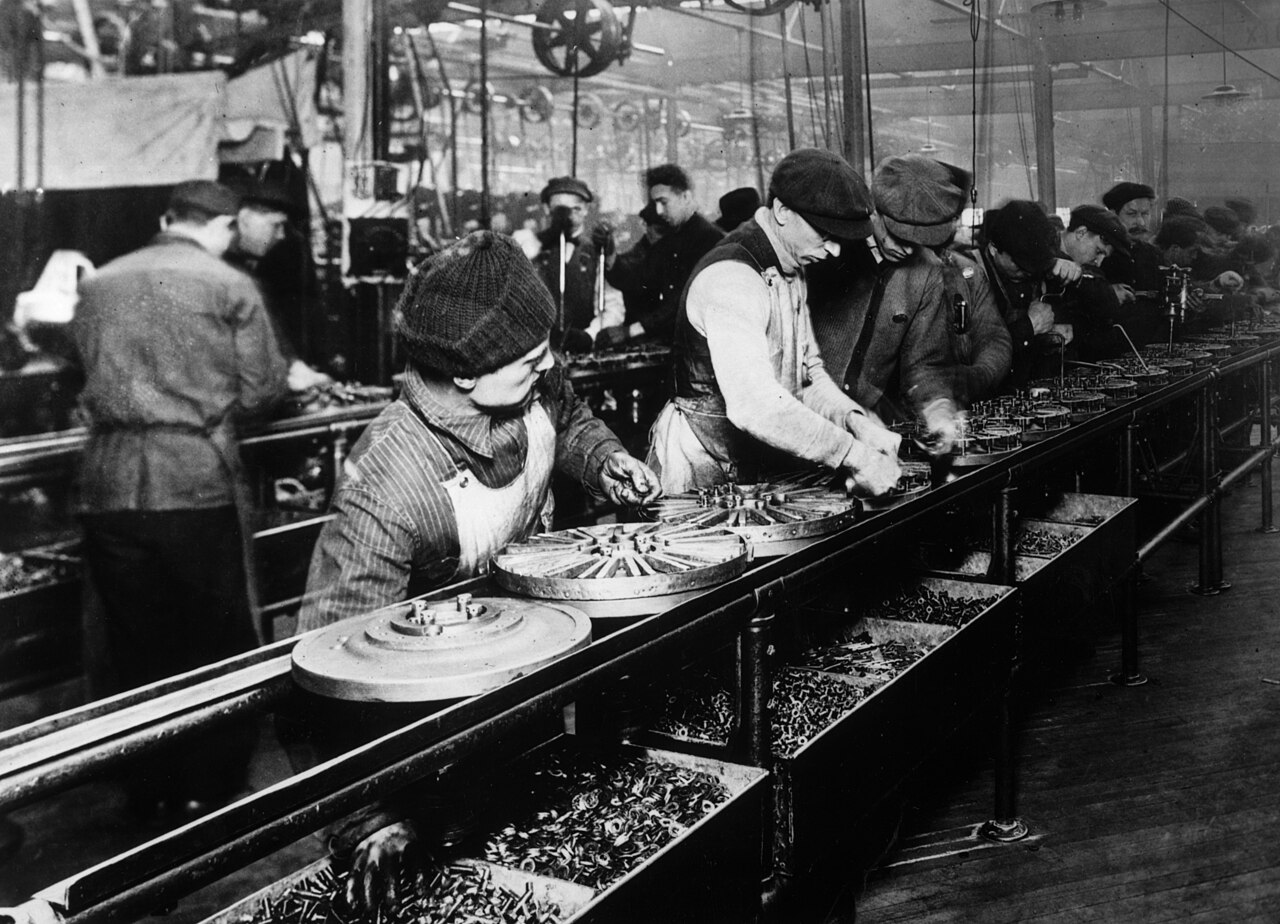 Image: Unknown authorUnknown author · Public domain · Source · Wikimedia Commons: Ford assembly line - 1913
Stream processing
A stream processor reads events from a log (such as Kafka), transforms them, and writes results to another log, a database or a dashboard.
Common operations: filter and enrich, aggregate, join streams, and detect patterns.
Time is the hard part
- Processing time: when the system sees the event.
- Event time: when it actually happened.
Phones go offline, networks lag, and events arrive late and out of order. Computing "clicks per minute" by arrival time gives wrong answers. Use event time.
Windows
Aggregations need boundaries:
Window Meaning Tumbling Fixed, non-overlapping (every minute) Sliding Overlapping (last 5 minutes, updated each minute) Session Grouped by activity, closed by a gap of inactivity Watermarks and late data
A watermark is the system's estimate of "we have seen everything up to event time T". When it passes the end of a window, the window can close and emit a result. Choosing the delay trades latency against completeness. Events arriving after the watermark are late: drop them, send them to a side output, or update the earlier result.
State and failures
Windows and joins need state. Engines such as Flink keep state locally and checkpoint it periodically to durable storage, together with the position in the input log. After a failure they restore the checkpoint and replay from that position.
Delivery guarantees
- At-most-once: may lose events.
- At-least-once: may duplicate on replay.
- Exactly-once effect: achieved by replayable sources, checkpointed state and idempotent or transactional sinks, so a replay does not change results.
Architectures that combine both
- Lambda architecture: a batch layer computes accurate views from all data, a speed layer gives fast approximations; the two are merged. Powerful but means writing logic twice.
- Kappa architecture: treat everything as a stream. Keep the log long enough to replay history through the same code when logic changes. Simpler, if your log and engine can handle it.
- Modern engines and the dataflow model increasingly unify batch and streaming under one API.
100%Figure SDA-BDP-02-2 · Lambda and Kappa architectures · © forcsguy.com
Choosing
Need Choice Nightly reports, big joins, model training on history Batch (Spark, SQL warehouse) Fraud detection, live dashboards, alerting, real-time features Streaming (Flink, Kafka Streams, Spark Structured Streaming) Both with minimal duplication Streaming core with replayable log, or a unified engine Real-world reading
Related reading
- MapReduce: Simplified Data Processing on Large Clusters (paper)Dean and Ghemawat · GooglePapers
- Cape: Event Stream Processing Framework at DropboxDropbox engineers · DropboxCase Studies
- Pagelets Parallelize Server-side Processing at YelpYelp engineers · YelpCase Studies
- Optimizing CAL Report Hadoop MapReduce Jobs at eBayeBay engineers · eBayCase Studies
Show 6 moreShow fewer
- Bullet: Forward-Looking Query Engine for Streaming Data at YahooYahoo engineers · YahooCase Studies
- Samza: Stream Processing System for Latency Insighs at LinkedInLinkedIn engineers · LinkedInCase Studies
- Netflix: What Happens When You Press Play?High Scalability engineers · High ScalabilityBlogs
- CMU Database GroupCarnegie Mellon UniversityYouTube
- Omid: Transaction Processing Platform at YahooYahoo engineers · YahooCase Studies
- Big Data Processing at UberUberPapers
Go deeper on this
A path through videos, articles, other case studies and code on the same ideas as Omid: Transaction Processing Platform at Yahoo.
ReadEngineers explain it in their own words.
Blogs
Adobe Research
Look into the future of innovation at Adobe Research
AdobeIntermediate
Blogs
Amazon Science
Technical deep-dives and perspectives from our scientists who are pushing boundaries across multiple scientific disciplines while solving real-world challenges. Explore how our teams combine research excellence, world...
AmazonIntermediate
WatchHow others solve the same problem, on video.
Videos belong to their creators and play from YouTube. More on YouTube (opens in a new tab)
See it in another companyThe same ideas, a different system.
Case Studies · Read here
Aroma: Using ML for Code Recommendation at Facebook
Thousands of engineers write the code to create our apps, which serve billions of people worldwide. This is no trivial task—our services have grown so diverse and complex that the codebase contains…
FacebookIntermediate
Case Studies · Read here
Concourse: Generating Personalized Content Notifications in Near-Real-Time at LinkedIn
Social media are computer-mediated platforms that facilitate creation and sharing of information, ideas, career interests, and other forms of expression via virtual communities and networks. In the last few years, not...
LinkedInIntermediate
Keep learning
Loading community…