Library / Case Studies
Samza: Stream Processing System for Latency Insighs at LinkedIn
Traditional request response metrics are fairly easy to measure. There is a clearly defined start time (when the request is received) and a clearly defined end time (when the last byte of the response is sent and the connection is closed).
By LinkedIn engineers · LinkedIn · Added 2026-10-12
All content belongs to LinkedIn engineers / LinkedIn. We only link to it and give credit. Report a problem
Learn this case study
About 37 min left. Your work is saved as you go.
What you are about to study
LinkedIn explains a real system. You should know the basics: caching, queues and replication.
Ideas you will meet
- Event Driven Architecture
- Loosely coupled services reacting to events.
- Distributed Systems
- Consensus, time, failure and the fundamentals of scale-out.
What we already know about this
Our own lessons on these ideas. Read them here before you start, so it makes sense.
Real-World Systems · 11 minDesign an AI coding assistantHow an editor assistant suggests code in under a second: gathering context, retrieval, the model, streaming and keeping private code safe.Read here
The problem
An assistant inside the editor that completes code as you type, answers questions in a chat panel, and can edit files. The hard constraints:
- Latency: inline suggestions must appear in roughly a few hundred milliseconds, or the user has already moved on.
- Relevance: good suggestions need the right context from a large codebase, not just the current line.
- Cost: language-model inference is expensive per request, and typing generates a request storm.
- Privacy and security: customer source code and secrets are sensitive.
- Quality: wrong or insecure suggestions must be limited and measurable.
Architecture
100%Figure SDA-RWS-18-1 · AI coding assistant architecture · © forcsguy.com
1. The editor extension
Runs in the user's editor. It watches typing, debounces requests (waits a few tens of milliseconds), cancels outdated requests when the user continues typing, and streams the suggestion into the editor as ghost text. It also handles accept, reject and partial accept, and enforces local privacy rules (excluded files, secret detection).
2. Building context
Prompt = instructions + context + the code around the cursor. Context comes from:
- The current file: the code before the cursor (prefix) and after it (suffix, for fill-in-the-middle).
- Open tabs and recently edited files.
- Imports and related files: definitions of functions and types being used.
- Retrieved snippets from the wider project.
All of it must fit the model's context window and a token budget, so the builder ranks pieces by relevance and trims.
3. Retrieval over a codebase
A repository is too big to include whole, so it is indexed:
- Split files into chunks (functions, classes, blocks).
- Compute embeddings (vectors capturing meaning) and store them in a vector index, together with a symbol and dependency graph (what calls what).
- At request time, search with the current code as the query and combine semantic results with structural ones (definitions, callers, tests).
- Update the index incrementally as files change, and keep per-user and per-organisation isolation.
4. Model serving
- A language model generates tokens. Serving systems batch many requests together, reuse a KV cache of already-processed prompt tokens, and stream output so the first words show immediately.
- Use smaller, faster models for inline completion and larger ones for chat and complex edits.
- Cache repeated prompts and completions where context is identical, and prefix-cache shared prompt parts.
- Autoscale GPU capacity, and route by region for latency.
5. Post-processing and safety
- Trim the output to a sensible stopping point (end of block or line).
- Filter secrets, personal data and known insecure patterns; optionally check for verbatim public code matches and licence concerns.
- Reject low-confidence suggestions instead of showing noise.
- For agents that edit files or run commands, require explicit user approval and run actions in a sandbox.
100%Figure SDA-RWS-18-2 · How a code model is trained and judged · © forcsguy.com
Latency budget
For inline suggestions, a budget like this keeps the experience smooth:
Step Target Debounce and local context about 30 ms Network to the service about 30 ms Retrieval and prompt building about 30 ms Model: time to first token about 150 ms Streaming and display continuous Everything else (retrieval, indexing, safety checks) must fit inside it or run asynchronously ahead of time.
Privacy, security and trust
- Send only what is needed, respect ignore files, and redact secrets.
- Provide enterprise controls: private deployment or isolated tenancy, no training on customer code, short retention, audit logs.
- Encrypt in transit and at rest; strong authentication and per-user quotas.
- Defend against prompt injection (malicious text in files or web pages trying to instruct the model): treat retrieved content as data, limit tool permissions, require confirmation for risky actions.
Measuring quality
- Offline evaluation: run the model on held-out code and tests, measure pass rates and exact-match similarity.
- Online metrics: acceptance rate of suggestions, characters kept after acceptance, latency percentiles, and errors.
- A/B test changes to prompts, models and retrieval, and watch for regressions in security and licence filters.
- Collect feedback signals (thumbs up or down) while respecting privacy.
What this design reuses
Debouncing and cancellation, caching, rate limiting and quotas, queues and batching, vector search, streaming responses and careful privacy controls: the same building blocks from the rest of this course, applied to a latency-sensitive AI workload.
Real-world reading
Related reading
- Secret Detector: Preventing Secrets in Source Code at YelpYelp engineers · YelpCase Studies
- Samza: Stream Processing System for Latency Insighs at LinkedInLinkedIn engineers · LinkedInCase Studies
- Use The Index, LukeMarkus Winand · use-the-index-luke.comCourses
- Backend Developer Roadmaproadmap.sh community · roadmap.shCourses
Show 6 moreShow fewer
- Natural Language Processing and Content Analysis (2 parts) at Condé NastCondé Nast engineers · Condé NastCase Studies
- Machine Learning for Indexing Text from Billions of Images at DropboxDropbox engineers · DropboxCase Studies
- Optimizing Web Servers for High Throughput and Low Latency at DropboxDropbox engineers · DropboxCase Studies
- Scalable User Privacy at SpotifySpotify engineers · SpotifyCase Studies
- Privacy-Preserving Analytics and Reporting at LinkedInLinkedIn engineers · LinkedInCase Studies
- Learning with Privacy at Scale at AppleScale at Apple engineers · Scale at AppleCase Studies
Big Data and Cloud Data Platforms · 12 minBatch and stream processingMapReduce and Spark for large batch jobs, and streaming concepts: event time, windows, watermarks and exactly-once results.Read here
Two ways to process data
- Batch: process a bounded dataset (yesterday's logs) as a job that starts, runs and finishes. High throughput, results later.
- Stream: process an unbounded flow of events continuously as they arrive. Low latency, harder to get right.
Most platforms need both: stream for fresh insight, batch for heavy recomputation and history.
Before: batch: a big job on a schedule
100%After: stream: process each event
100%What changed
- Results arrive in seconds instead of hours
- Late and duplicate events must be handled
- Batch stays useful for reprocessing history
Batch: the MapReduce idea
Word count is the classic example.
100%Figure SDA-BDP-02-1 · MapReduce word count flow · © forcsguy.com
- Map: each worker reads a slice and emits key-value pairs (
("system", 1)). - Shuffle: the framework groups all pairs with the same key and sends them to the same reducer. This is the expensive step (network and sorting).
- Reduce: each reducer combines the values for its keys (
("system", 4812)).
Failures are handled by re-running tasks, which is possible because inputs are immutable and tasks have no side effects.
Spark improved this model: it keeps intermediate data in memory, expresses jobs as chains of transformations on DataFrames (with a query optimiser), and offers SQL, machine learning and streaming APIs on one engine. Today you usually write Spark or SQL, not raw MapReduce.
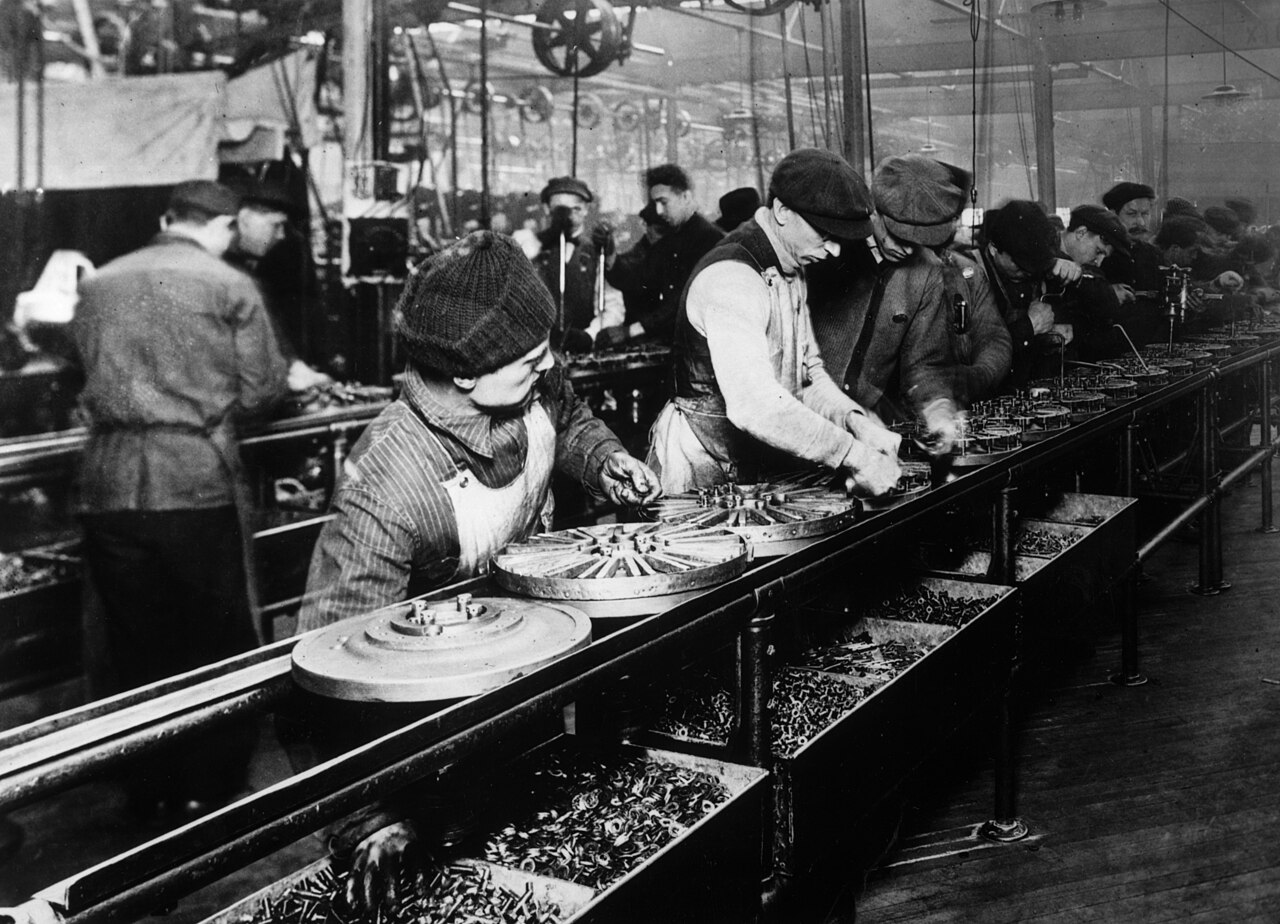 Image: Unknown authorUnknown author · Public domain · Source · Wikimedia Commons: Ford assembly line - 1913
Stream processing
A stream processor reads events from a log (such as Kafka), transforms them, and writes results to another log, a database or a dashboard.
Common operations: filter and enrich, aggregate, join streams, and detect patterns.
Time is the hard part
- Processing time: when the system sees the event.
- Event time: when it actually happened.
Phones go offline, networks lag, and events arrive late and out of order. Computing "clicks per minute" by arrival time gives wrong answers. Use event time.
Windows
Aggregations need boundaries:
Window Meaning Tumbling Fixed, non-overlapping (every minute) Sliding Overlapping (last 5 minutes, updated each minute) Session Grouped by activity, closed by a gap of inactivity Watermarks and late data
A watermark is the system's estimate of "we have seen everything up to event time T". When it passes the end of a window, the window can close and emit a result. Choosing the delay trades latency against completeness. Events arriving after the watermark are late: drop them, send them to a side output, or update the earlier result.
State and failures
Windows and joins need state. Engines such as Flink keep state locally and checkpoint it periodically to durable storage, together with the position in the input log. After a failure they restore the checkpoint and replay from that position.
Delivery guarantees
- At-most-once: may lose events.
- At-least-once: may duplicate on replay.
- Exactly-once effect: achieved by replayable sources, checkpointed state and idempotent or transactional sinks, so a replay does not change results.
Architectures that combine both
- Lambda architecture: a batch layer computes accurate views from all data, a speed layer gives fast approximations; the two are merged. Powerful but means writing logic twice.
- Kappa architecture: treat everything as a stream. Keep the log long enough to replay history through the same code when logic changes. Simpler, if your log and engine can handle it.
- Modern engines and the dataflow model increasingly unify batch and streaming under one API.
100%Figure SDA-BDP-02-2 · Lambda and Kappa architectures · © forcsguy.com
Choosing
Need Choice Nightly reports, big joins, model training on history Batch (Spark, SQL warehouse) Fraud detection, live dashboards, alerting, real-time features Streaming (Flink, Kafka Streams, Spark Structured Streaming) Both with minimal duplication Streaming core with replayable log, or a unified engine Real-world reading
Related reading
- MapReduce: Simplified Data Processing on Large Clusters (paper)Dean and Ghemawat · GooglePapers
- Cape: Event Stream Processing Framework at DropboxDropbox engineers · DropboxCase Studies
- Pagelets Parallelize Server-side Processing at YelpYelp engineers · YelpCase Studies
- Optimizing CAL Report Hadoop MapReduce Jobs at eBayeBay engineers · eBayCase Studies
Show 6 moreShow fewer
- Bullet: Forward-Looking Query Engine for Streaming Data at YahooYahoo engineers · YahooCase Studies
- Samza: Stream Processing System for Latency Insighs at LinkedInLinkedIn engineers · LinkedInCase Studies
- Netflix: What Happens When You Press Play?High Scalability engineers · High ScalabilityBlogs
- CMU Database GroupCarnegie Mellon UniversityYouTube
- Omid: Transaction Processing Platform at YahooYahoo engineers · YahooCase Studies
- Big Data Processing at UberUberPapers
Software Design Essentials · 11 minBehavioural patterns: Strategy, Observer, Command, StatePatterns for how objects cooperate: swapping algorithms, reacting to events, turning actions into objects and changing behaviour with state.Read here
The goal
Behavioural patterns distribute responsibility between objects and define how they communicate.
Strategy
Define a family of interchangeable algorithms behind an interface and pick one at runtime.
type Pricing = (subtotalCents: number) => number;

const regular: Pricing = (s) => s;
const member:  Pricing = (s) => Math.round(s * 0.9);
const blackFriday: Pricing = (s) => Math.round(s * 0.7);

function checkout(subtotal: number, pricing: Pricing) { return pricing(subtotal); }
checkout(10_000, member);   // the strategy is passed in
Replaces long
if/elseorswitchchains and supports the open/closed principle. In languages with first-class functions the "strategy" is simply a function you pass in.Observer (publish and subscribe)
Objects subscribe to a subject and are notified when it changes, without the subject knowing who listens.
class Emitter<T> {
  private handlers = new Set<(v: T) => void>();
  on(h: (v: T) => void) { this.handlers.add(h); return () => this.handlers.delete(h); } // returns "unsubscribe"
  emit(v: T) { this.handlers.forEach((h) => h(v)); }
}
const cart = new Emitter<number>();
const stop = cart.on((count) => updateBadge(count));
cart.emit(3);
stop();                                              // always clean up
Used for UI events, domain events and message buses. Watch for leaks (forgotten unsubscribes), ordering surprises and cascades of updates that are hard to follow.
Observer as a picture
100%Figure SDA-SDE-05-1 · One subject, many observers · © forcsguy.com
Command
Turn a request into an object containing everything needed to run it. That lets you queue, log, retry, schedule and undo it.
interface Command { run(): void; undo(): void }

class InsertText implements Command {
  constructor(private doc: Doc, private at: number, private text: string) {}
  run()  { this.doc.insert(this.at, this.text); }
  undo() { this.doc.remove(this.at, this.text.length); }
}

const history: Command[] = [];
function perform(c: Command) { c.run(); history.push(c); }
function undo() { history.pop()?.undo(); }
Editors, job queues, macros and transaction logs all use it.
State
Let an object change behaviour when its internal state changes, by delegating to a state object (or a transition table).
type State = "new" | "paid" | "shipped" | "cancelled";
const next: Record<State, Partial<Record<"pay" | "ship" | "cancel", State>>> = {
  new:       { pay: "paid", cancel: "cancelled" },
  paid:      { ship: "shipped", cancel: "cancelled" },
  shipped:   {},
  cancelled: {},
};
function apply(state: State, action: "pay" | "ship" | "cancel"): State {
  const to = next[state][action];
  if (!to) throw new Error(`Cannot ${action} an order that is ${state}`);
  return to;
}
Makes illegal transitions explicit and impossible, replacing scattered flags and nested conditions.
Template Method
Define the skeleton of an algorithm in one place and let steps vary.
abstract class Importer {
  run() { const raw = this.read(); const rows = this.parse(raw); this.save(rows); } // fixed order
  protected abstract read(): string;
  protected abstract parse(raw: string): Row[];
  protected save(rows: Row[]) { /* default */ }
}
Frameworks use it widely ("override these hooks"). With functions, you can pass the varying steps in instead of subclassing.
Chain of Responsibility
Pass a request along a chain of handlers until one handles it (or each adds something). Middleware pipelines in web servers are this pattern.
type Handler = (req: Req, next: () => Promise<Res>) => Promise<Res>;
// authenticate -> rateLimit -> validate -> handle
Iterator and others
- Iterator: walk a collection without exposing its structure. In most languages this is built in (
for...of, generators). - Mediator: one object coordinates many (a chat room, a form controller) so participants do not reference each other.
- Memento: capture and restore an object's state (undo snapshots).
- Visitor: add new operations over a structure of object types without modifying them; common in compilers.
- Interpreter: evaluate expressions of a small language.
Choosing
Problem Pattern Many alternative algorithms or rules Strategy React to changes without coupling Observer Undo, queue, log or retry actions Command Behaviour depends on lifecycle state State Same steps, different details Template Method A pipeline of optional processing steps Chain of Responsibility Remember: with first-class functions many of these become callbacks, closures and tables. Use the lightest form that keeps the code clear.
Real-world reading
Related reading
- Cape: Event Stream Processing Framework at DropboxDropbox engineers · DropboxCase Studies
- NATS ServerNATS · CNCF / NATSGitHub
- Samza: Stream Processing System for Latency Insighs at LinkedInLinkedIn engineers · LinkedInCase Studies
- Autoscaling AWS Step Functions Activities at YelpYelp engineers · YelpCase Studies
Show 6 moreShow fewer
- Distributed Messaging, Queuing, and Event StreamingArxivPapers
- Steady State: Always Put Logs on Separate DiskMicrosoft engineers · MicrosoftCase Studies
- Self-Serve Reporting Platform on Hadoop at LinkedInLinkedInPapers
- Ambry: Distributed Immutable Object Store at LinkedInLinkedIn engineers · LinkedInCase Studies
- Benchmarking Streaming Computation Engines at YahooYahoo engineers · YahooCase Studies
- NodeJS High Availability at YahooYahoo engineers · YahooCase Studies
- Iterator: walk a collection without exposing its structure. In most languages this is built in (
Go deeper on this
A path through videos, articles, other case studies and code on the same ideas as Samza: Stream Processing System for Latency Insighs at LinkedIn.
Warm upGet the vocabulary first.
Documentation
Apache Flink: Concepts overview
Stateful stream processing concepts: time, windows, state and fault tolerance.
Apache Software FoundationAdvanced
Books · Free from the author
Concurrent and Distributed Systems (Cambridge lecture notes)
Eight lectures on time, broadcast, replication, consensus and transactions, with notes, slides and video. Free from the author under CC BY-SA.
University of CambridgeIntermediate
WatchHow others solve the same problem, on video.
Videos belong to their creators and play from YouTube. More on YouTube (opens in a new tab)
ReadEngineers explain it in their own words.
Papers
Kafka - Message Broker
Apache Kafka is a scalable message broker , and Apache Samza is a stream processing framework built upon Kafka. They are widely used as infrastructure for implementing personalized online services and real-time predic...
KleppmannIntermediate
Papers
Distributed Messaging, Queuing, and Event Streaming
This paper surveys the message brokers that are in vogue today for distributed communication. Their primary goal is to facilitate the construction of decentralized topologies without single points of failure, enabling...
ArxivIntermediate
See it in another companyThe same ideas, a different system.
Case Studies · Read here
Brooklin: Distributed Service for Near Real-Time Data Streaming at LinkedIn
Brooklin—a distributed service for streaming data in near real-time and at scale—has been running in production at LinkedIn since 2016, powering thousands of data streams and over 2 trillion messages per day. Today, w...
LinkedInIntermediate
Case Studies · Read here
Delaying Asynchronous Message Processing with RabbitMQ at Indeed
By implementing a delay queue for our message processing, we improved the resilience of our internal systems and were able to deliver jobs more reliably.
IndeedIntermediate
Read the codeSee how it looks when it is real.
GitHub
Awesome Microservices
Curated tools, frameworks and reading material for building microservice systems.
mfornosIntermediate
GitHub
Engineering Blogs
A huge directory of company engineering blogs to learn from real production systems.
kilimchoiIntermediate
Keep learning
Loading community…