Library / Case Studies
Bullet: Forward-Looking Query Engine for Streaming Data at Yahoo
A real-world engineering write-up from Yahoo on distributed Messaging, Queuing, and Event Streaming.
By Yahoo engineers · Yahoo · Added 2026-10-12
All content belongs to Yahoo engineers / Yahoo. We only link to it and give credit. Report a problem
Learn this case study
About 37 min left. Your work is saved as you go.
What you are about to study
Yahoo explains a real system. You should know the basics: caching, queues and replication.
Ideas you will meet
- Event Driven Architecture
- Loosely coupled services reacting to events.
- Distributed Systems
- Consensus, time, failure and the fundamentals of scale-out.
What we already know about this
Our own lessons on these ideas. Read them here before you start, so it makes sense.
Real-World Systems · 13 minDesign a stock exchangeAn order book, a matching engine and a sequencer: how an exchange matches buyers and sellers fairly in microseconds.Read here
The problem
An exchange lets buyers and sellers trade. Participants submit orders; the exchange matches them and reports the trades.
Key properties:
- Fairness: orders are handled in a strict, auditable order.
- Very low latency: microseconds from order to acknowledgment.
- High throughput: hundreds of thousands to millions of orders per second at peaks.
- Correctness and durability: money is involved. No lost or duplicated trades.
- Availability: an exchange outage halts a market.
The order book
For each symbol the order book holds resting orders:
- Bids (buy orders), highest price first.
- Asks (sell orders), lowest price first.
- Within a price level, orders queue by arrival time.
Common order types: limit (a worst price you accept; unmatched part rests in the book) and market (take the best available now).
Matching: price-time priority
An incoming buy matches the lowest-priced asks it can afford; among equal prices the earliest order matches first. Matching repeats until the order is filled or no longer matches, and any remainder rests in the book.
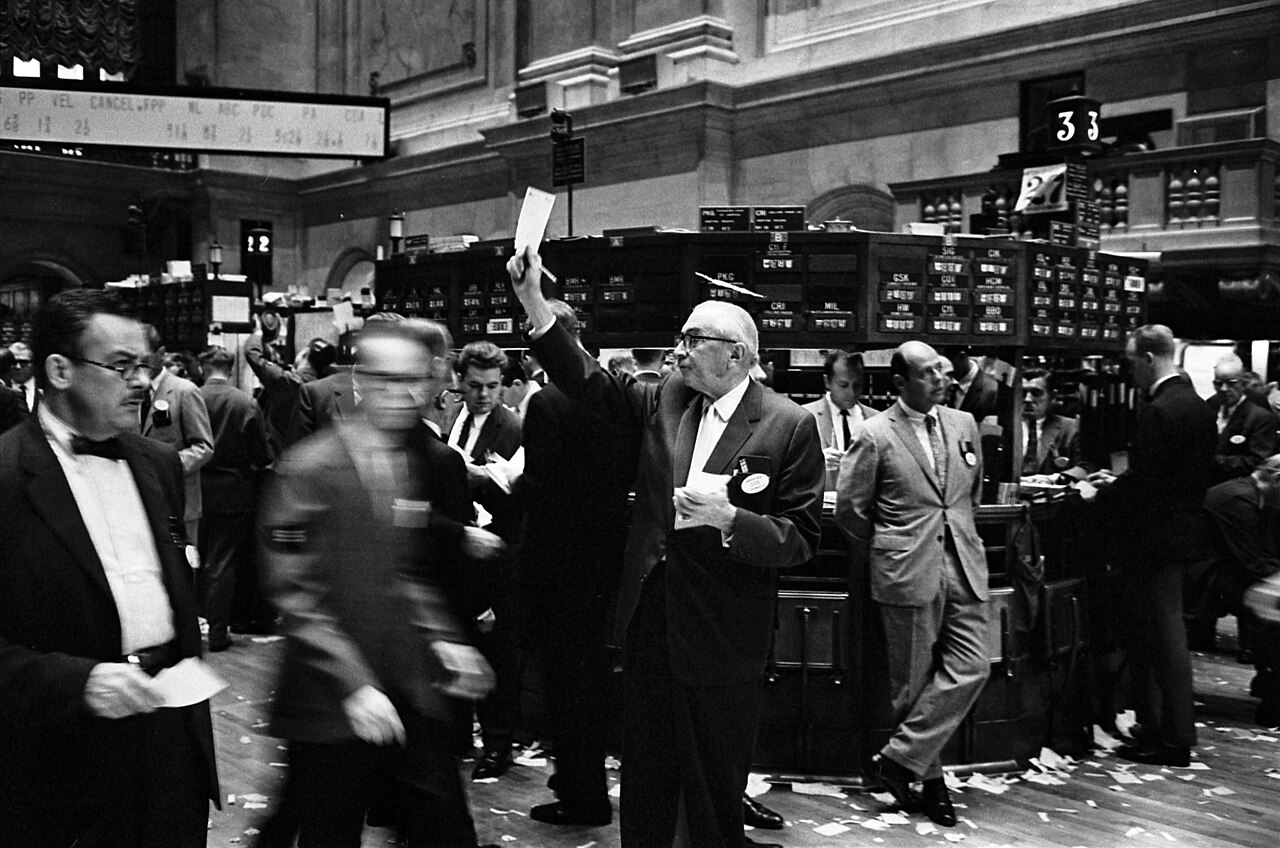 Image: Thomas J. O'Halloran · Public domain · Source · Wikimedia Commons: NY stock exchange traders floor LC-U9-10548-6
Architecture
100%Figure SDA-RWS-05-1 · Exchange: gateway, sequencer, matching engine · © forcsguy.com
- Gateways authenticate participants, validate orders, and run pre-trade risk checks (limits, available funds).
- The sequencer gives every event a sequence number: one agreed total order, the basis of fairness and recovery.
- A matching engine applies events in order to the in-memory order book and emits trades.
- Everything is written to a durable event log. Executions go to participants, and a market data stream tells everyone about prices and depth.
- Clearing and settlement later move money and securities between accounts.
100%Figure SDA-RWS-05-2 · An order book with a buy order sweeping the sell side · © forcsguy.com
How it gets so fast
- In-memory order books and no database in the critical path.
- Single-threaded matching per symbol group: no locks, deterministic behaviour. Parallelism comes from partitioning symbols across engines.
- Event sourcing: state is the result of applying an ordered log. Persist the event first (to a memory-mapped file or replicated log), then process.
- Pre-allocated memory, ring buffers, no garbage-collection pauses, and careful cache-friendly data structures.
- Hardware and network: servers co-located in the exchange's data centre, fast network cards and kernel-bypass networking, precise time sources.
100%Figure SDA-RWS-05-3 · A fast engine on one machine: shared log and busy loops · © forcsguy.com
Reliability
- A hot standby applies the same event log and can take over within moments. Use sequence numbers to detect gaps and avoid duplicate processing.
- Replicate the log across machines or sites before acknowledging, trading a little latency for durability.
- Idempotent order identifiers prevent a resubmitted order executing twice.
- Circuit breakers halt trading when prices move too fast.
Market data fairness
Everyone should see the same information at about the same time. Exchanges publish through multicast feeds, give all participants equal-length cables inside the data centre, and timestamp events at the matching engine. A separate, slower snapshot and retransmission service helps receivers that miss packets.
What is out of scope here
Clearing houses, settlement cycles, regulation and surveillance are large systems of their own. The core design is the sequencer plus deterministic matching engine plus durable log.
Real-world reading
Related reading
- Event SourcingMartin FowlerBlogs
- Monolith FirstMartin FowlerBlogs
- Rewriting the heart of our sync engineDropboxCase Studies
- Cape: Event Stream Processing Framework at DropboxDropbox engineers · DropboxCase Studies
Show 6 moreShow fewer
- Improving Search Engine Efficiency by over 25% at eBayeBay engineers · eBayCase Studies
- Finding Kafka throughput limit in infrastructure at DropboxDropbox engineers · DropboxCase Studies
- Bullet: Forward-Looking Query Engine for Streaming Data at YahooYahoo engineers · YahooCase Studies
- MicroservicesJames Lewis and Martin Fowler · Martin FowlerBlogs
- The LMAX ArchitectureMartin FowlerCase Studies
- Microservices and OrchestrationMartinfowler engineers · MartinfowlerCase Studies
Big Data and Cloud Data Platforms · 12 minBatch and stream processingMapReduce and Spark for large batch jobs, and streaming concepts: event time, windows, watermarks and exactly-once results.Read here
Two ways to process data
- Batch: process a bounded dataset (yesterday's logs) as a job that starts, runs and finishes. High throughput, results later.
- Stream: process an unbounded flow of events continuously as they arrive. Low latency, harder to get right.
Most platforms need both: stream for fresh insight, batch for heavy recomputation and history.
Before: batch: a big job on a schedule
100%After: stream: process each event
100%What changed
- Results arrive in seconds instead of hours
- Late and duplicate events must be handled
- Batch stays useful for reprocessing history
Batch: the MapReduce idea
Word count is the classic example.
100%Figure SDA-BDP-02-1 · MapReduce word count flow · © forcsguy.com
- Map: each worker reads a slice and emits key-value pairs (
("system", 1)). - Shuffle: the framework groups all pairs with the same key and sends them to the same reducer. This is the expensive step (network and sorting).
- Reduce: each reducer combines the values for its keys (
("system", 4812)).
Failures are handled by re-running tasks, which is possible because inputs are immutable and tasks have no side effects.
Spark improved this model: it keeps intermediate data in memory, expresses jobs as chains of transformations on DataFrames (with a query optimiser), and offers SQL, machine learning and streaming APIs on one engine. Today you usually write Spark or SQL, not raw MapReduce.
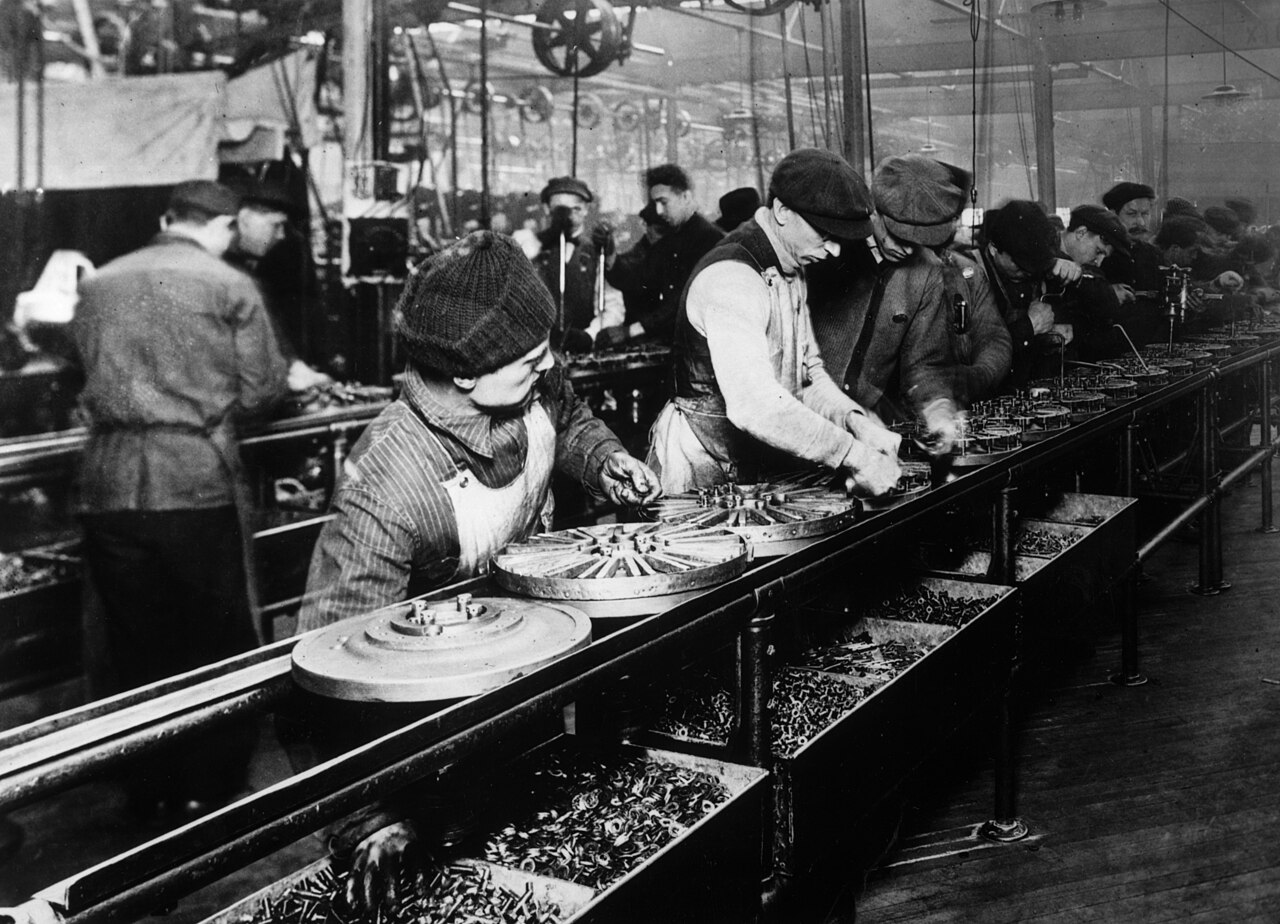 Image: Unknown authorUnknown author · Public domain · Source · Wikimedia Commons: Ford assembly line - 1913
Stream processing
A stream processor reads events from a log (such as Kafka), transforms them, and writes results to another log, a database or a dashboard.
Common operations: filter and enrich, aggregate, join streams, and detect patterns.
Time is the hard part
- Processing time: when the system sees the event.
- Event time: when it actually happened.
Phones go offline, networks lag, and events arrive late and out of order. Computing "clicks per minute" by arrival time gives wrong answers. Use event time.
Windows
Aggregations need boundaries:
Window Meaning Tumbling Fixed, non-overlapping (every minute) Sliding Overlapping (last 5 minutes, updated each minute) Session Grouped by activity, closed by a gap of inactivity Watermarks and late data
A watermark is the system's estimate of "we have seen everything up to event time T". When it passes the end of a window, the window can close and emit a result. Choosing the delay trades latency against completeness. Events arriving after the watermark are late: drop them, send them to a side output, or update the earlier result.
State and failures
Windows and joins need state. Engines such as Flink keep state locally and checkpoint it periodically to durable storage, together with the position in the input log. After a failure they restore the checkpoint and replay from that position.
Delivery guarantees
- At-most-once: may lose events.
- At-least-once: may duplicate on replay.
- Exactly-once effect: achieved by replayable sources, checkpointed state and idempotent or transactional sinks, so a replay does not change results.
Architectures that combine both
- Lambda architecture: a batch layer computes accurate views from all data, a speed layer gives fast approximations; the two are merged. Powerful but means writing logic twice.
- Kappa architecture: treat everything as a stream. Keep the log long enough to replay history through the same code when logic changes. Simpler, if your log and engine can handle it.
- Modern engines and the dataflow model increasingly unify batch and streaming under one API.
100%Figure SDA-BDP-02-2 · Lambda and Kappa architectures · © forcsguy.com
Choosing
Need Choice Nightly reports, big joins, model training on history Batch (Spark, SQL warehouse) Fraud detection, live dashboards, alerting, real-time features Streaming (Flink, Kafka Streams, Spark Structured Streaming) Both with minimal duplication Streaming core with replayable log, or a unified engine Real-world reading
Related reading
- MapReduce: Simplified Data Processing on Large Clusters (paper)Dean and Ghemawat · GooglePapers
- Cape: Event Stream Processing Framework at DropboxDropbox engineers · DropboxCase Studies
- Pagelets Parallelize Server-side Processing at YelpYelp engineers · YelpCase Studies
- Optimizing CAL Report Hadoop MapReduce Jobs at eBayeBay engineers · eBayCase Studies
Show 6 moreShow fewer
- Bullet: Forward-Looking Query Engine for Streaming Data at YahooYahoo engineers · YahooCase Studies
- Samza: Stream Processing System for Latency Insighs at LinkedInLinkedIn engineers · LinkedInCase Studies
- Netflix: What Happens When You Press Play?High Scalability engineers · High ScalabilityBlogs
- CMU Database GroupCarnegie Mellon UniversityYouTube
- Omid: Transaction Processing Platform at YahooYahoo engineers · YahooCase Studies
- Big Data Processing at UberUberPapers
Big Data and Cloud Data Platforms · 11 minData lakes, warehouses and lakehousesWhere analytical data lives and why: OLTP versus OLAP, columnar files, ETL versus ELT, and open table formats.Read here
Two kinds of workload
OLTP (transactions) OLAP (analytics) Purpose Run the application Understand the business Queries Many small reads and writes of single rows Few large scans and aggregations over many rows Storage layout Row oriented Column oriented Examples PostgreSQL, MySQL for an order system A warehouse for revenue by region and month Running heavy analytics on the production database slows the application, so analytical data is copied into systems built for it.
Columnar storage and file formats
Analytical queries typically read a few columns across millions of rows. Storing data by column means:
- A query reads only the columns it needs.
- Values in one column are similar, so they compress extremely well.
- Engines can skip chunks using min/max statistics.
Parquet and ORC are the standard open columnar file formats. Compared with CSV or JSON they are much smaller and faster to query.
Three architectures
100%Figure SDA-BDP-03-1 · Three architectures · © forcsguy.com
Data warehouse
A curated, structured store optimised for SQL analytics, with a defined schema (often a star schema: a central fact table of events such as sales, surrounded by dimension tables such as customer, product and date). Reliable and fast, but historically costly and rigid with raw or unstructured data.
Data lake
Raw files of any format kept cheaply in object storage, with schema applied when read. Flexible and cheap, and good for machine learning and unstructured data. Risks: no transactions, inconsistent data and "data swamps" nobody trusts.
Lakehouse
The two combined: files in open formats on object storage, with a table format adding the warehouse features.
- Delta Lake, Apache Iceberg, Apache Hudi: a transaction log or metadata layer that provides ACID transactions, schema evolution, time travel (query data as it was), and efficient updates and deletes.
- One copy of data serves BI, SQL, streaming and machine learning, using different engines (Spark, Trino, warehouses) on the same tables.
Moving data: ETL and ELT
- ETL: extract, transform, then load. Transformation happens before the data reaches the warehouse.
- ELT: extract, load raw, then transform inside the warehouse or lake engine. Common today, since storage is cheap, compute is elastic, and you keep the raw data to reprocess.
- Change data capture (CDC) streams database changes into the lake continuously, instead of nightly dumps.
Organising data: layers
A common pattern, sometimes called medallion layers:
- Raw (bronze): exactly as received.
- Cleaned (silver): deduplicated, typed, validated.
- Business-ready (gold): modelled tables and aggregates for reports.
Good practice
- Partition large tables (by date, for example) so queries scan less.
- Keep files a sensible size (hundreds of MB); many tiny files slow everything.
- Enforce data quality checks and schemas at ingestion.
- Provide a catalogue (what data exists, who owns it, lineage) and access controls (row, column and table level).
- Track cost: scanning unpartitioned petabytes is expensive.
- Separate storage from compute so different teams scale their engines independently.
Real-world reading
Related reading
- Cassandra: A Decentralized Structured Storage System (paper)Lakshman and Malik · FacebookPapers
- The Architecture of Open Source ApplicationsVarious authors · aosabook.orgBooks
- HaloDB: Embedded Key-Value Storage Engine at YahooYahoo engineers · YahooCase Studies
- Bullet: Forward-Looking Query Engine for Streaming Data at YahooYahoo engineers · YahooCase Studies
Show 6 moreShow fewer
- Improving Stream Data Quality With Protobuf Schema Validation at DeliverooDeliveroo engineers · DeliverooCase Studies
- Continuous Load Testing at SlackSlack engineers · SlackCase Studies
- Druid - Real-time Analytics DatabaseApache engineers · ApacheDocumentation
- MPH: Fast and Compact Immutable Key-Value Stores at IndeedIndeed engineers · IndeedCase Studies
- Venice: Distributed Key-Value Database at LinkedinLinkedin engineers · LinkedinCase Studies
- Data Wrangling at SlackSlack engineers · SlackCase Studies
Go deeper on this
A path through videos, articles, other case studies and code on the same ideas as Bullet: Forward-Looking Query Engine for Streaming Data at Yahoo.
Warm upGet the vocabulary first.
Documentation
Apache Flink: Concepts overview
Stateful stream processing concepts: time, windows, state and fault tolerance.
Apache Software FoundationAdvanced
Books · Free from the author
Concurrent and Distributed Systems (Cambridge lecture notes)
Eight lectures on time, broadcast, replication, consensus and transactions, with notes, slides and video. Free from the author under CC BY-SA.
University of CambridgeIntermediate
WatchHow others solve the same problem, on video.
Videos belong to their creators and play from YouTube. More on YouTube (opens in a new tab)
ReadEngineers explain it in their own words.
Papers
Kafka - Message Broker
Apache Kafka is a scalable message broker , and Apache Samza is a stream processing framework built upon Kafka. They are widely used as infrastructure for implementing personalized online services and real-time predic...
KleppmannIntermediate
Papers
Distributed Messaging, Queuing, and Event Streaming
This paper surveys the message brokers that are in vogue today for distributed communication. Their primary goal is to facilitate the construction of decentralized topologies without single points of failure, enabling...
ArxivIntermediate
See it in another companyThe same ideas, a different system.
Case Studies · Read here
Brooklin: Distributed Service for Near Real-Time Data Streaming at LinkedIn
Brooklin—a distributed service for streaming data in near real-time and at scale—has been running in production at LinkedIn since 2016, powering thousands of data streams and over 2 trillion messages per day. Today, w...
LinkedInIntermediate
Case Studies · Read here
Delaying Asynchronous Message Processing with RabbitMQ at Indeed
By implementing a delay queue for our message processing, we improved the resilience of our internal systems and were able to deliver jobs more reliably.
IndeedIntermediate
Read the codeSee how it looks when it is real.
GitHub
Awesome Microservices
Curated tools, frameworks and reading material for building microservice systems.
mfornosIntermediate
GitHub
Engineering Blogs
A huge directory of company engineering blogs to learn from real production systems.
kilimchoiIntermediate
Keep learning
Loading community…